
If someone you know has hearing loss, you might have noticed something. It’s not just about volume. It’s about position. About light. About whether you’re facing them when you speak.
Hearing loss — particularly the kind that creeps up gradually, as it does for most people — changes the way we process conversation. The brain works harder. It starts to fill gaps. And to do that, it draws on everything available: the movement of lips, the expression on a face, the posture of a body, the context of the moment.
This is why being in the same room as someone matters so much more than people often realise.
More than just hearing
When we talk about lipreading, most people picture someone watching lips. And yes, that’s part of it. But skilled lipreaders — and most people with hearing loss develop some degree of this skill without even knowing it — are actually reading far more than lips.
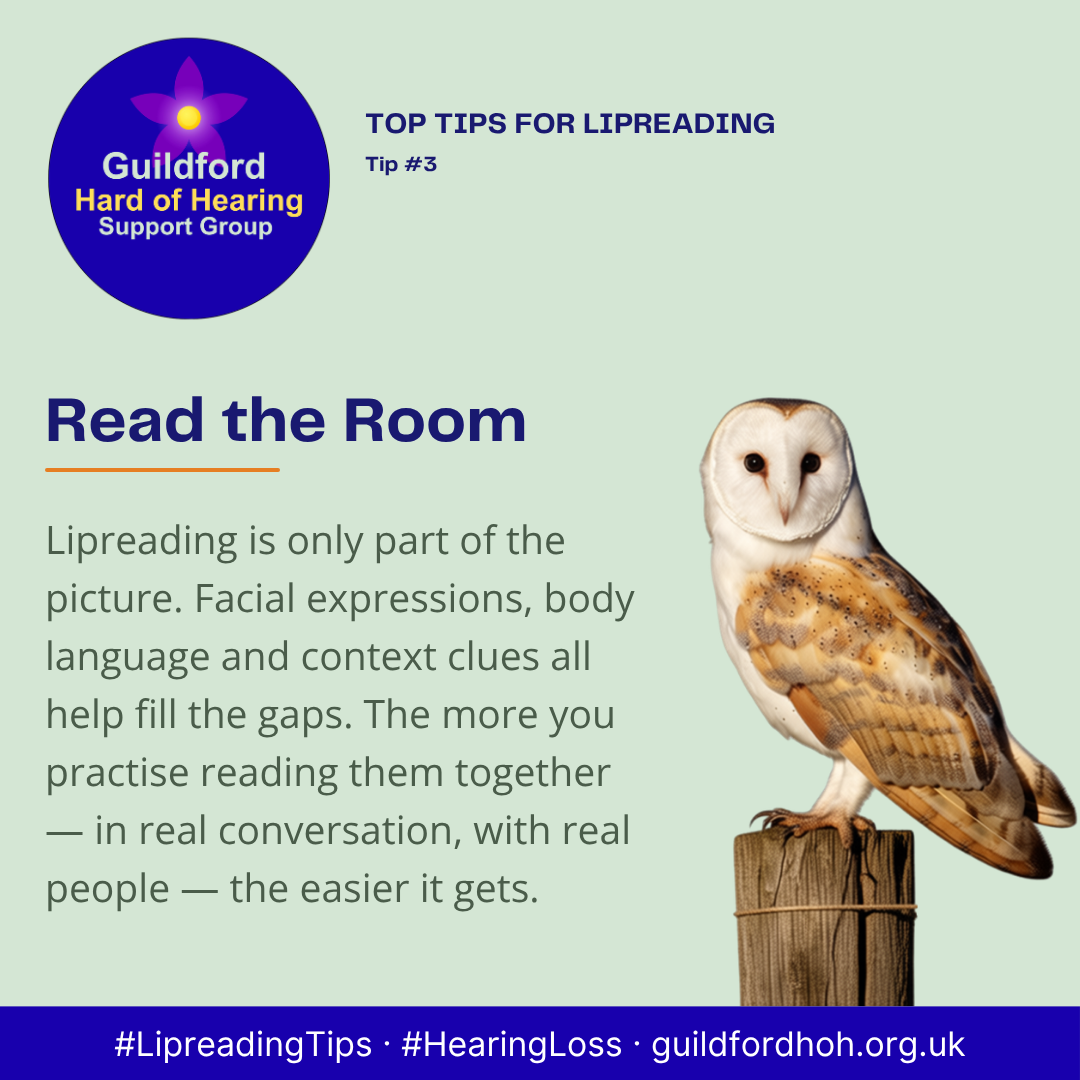
They’re reading facial expressions. The slight raise of an eyebrow that signals a question. The smile that tells you something was meant as a joke, not a complaint. They’re reading body language — the lean forward that means ‘I’m interested’, the glance away that means ‘I’ve nearly finished’. And they’re reading context — using what they know about the situation, the topic, the person, to make educated predictions about what was just said.
None of this works over the phone. Very little of it works on a video call, where lighting is unpredictable, faces are small, and the signal drops at exactly the wrong moment. And none of it — none — can be learned from a YouTube video or a leaflet.
Why practice needs to be real
There’s a lot of excellent information online about hearing loss. NHS guidance, audiology resources, YouTube explainers. They’re genuinely useful for understanding what’s happening and why.
But understanding something and being able to do it are very different things. Reading about how to ride a bike doesn’t help much when you’re wobbling down the road. The same is true of communication strategies for hearing loss. You can read about asking people to face you when they speak. But doing it — in a real conversation, with real social dynamics, in a real room — takes practice. And ideally, it takes practice with people who understand exactly what you’re going through.
That peer element is something no online resource can replicate. Sitting with other people who are navigating the same challenges — who know the fatigue of a noisy restaurant, the frustration of missing a punchline, the effort of concentrating intensely in every conversation — is both practically useful and quietly reassuring.
What you can do right now
Whether you’re dealing with hearing loss yourself, or you live or work alongside someone who is, there are small things that make a significant difference:
• Face the person you’re talking to. Fully — not at a slight angle.
• Make sure light falls on your face, not behind you.
• Don’t cover your mouth when you speak.
• Say what you’re about to talk about before diving in — context helps enormously.
• If you’re with someone who has hearing loss, sit across from them rather than side by side.
These are the kinds of strategies that feel obvious once you know them, but make a real difference in daily life.
Ready to go further?
If you’d like to develop these skills properly — in a structured, supportive, face-to-face setting — the Managing Hearing Loss Course might be exactly what you’re looking for.
Run by Guildford Hard of Hearing Support Group, this six-week course covers lipreading, communication strategies, hearing technology, and more. It starts on 21 September 2026 at the United Reformed Church in Guildford, and costs just £34 — including GHOHSG membership.
Genuinely face-to-face lipreading tuition is becoming rare. This is a chance to do it properly, with people who understand.
👉 View the full course syllabus and book your place at guildfordhoh.org.uk/managing-hearing-loss-course-2026