
When I walked into the Unitarian Hall in Godalming one evening about a year ago, there was something different about it. The Unitarians had fitted acoustic panels in the high arched ceiling. Sneaky – didn't mention they would do this. I made a point of emailing them the next day, congratulating them on such a good move.
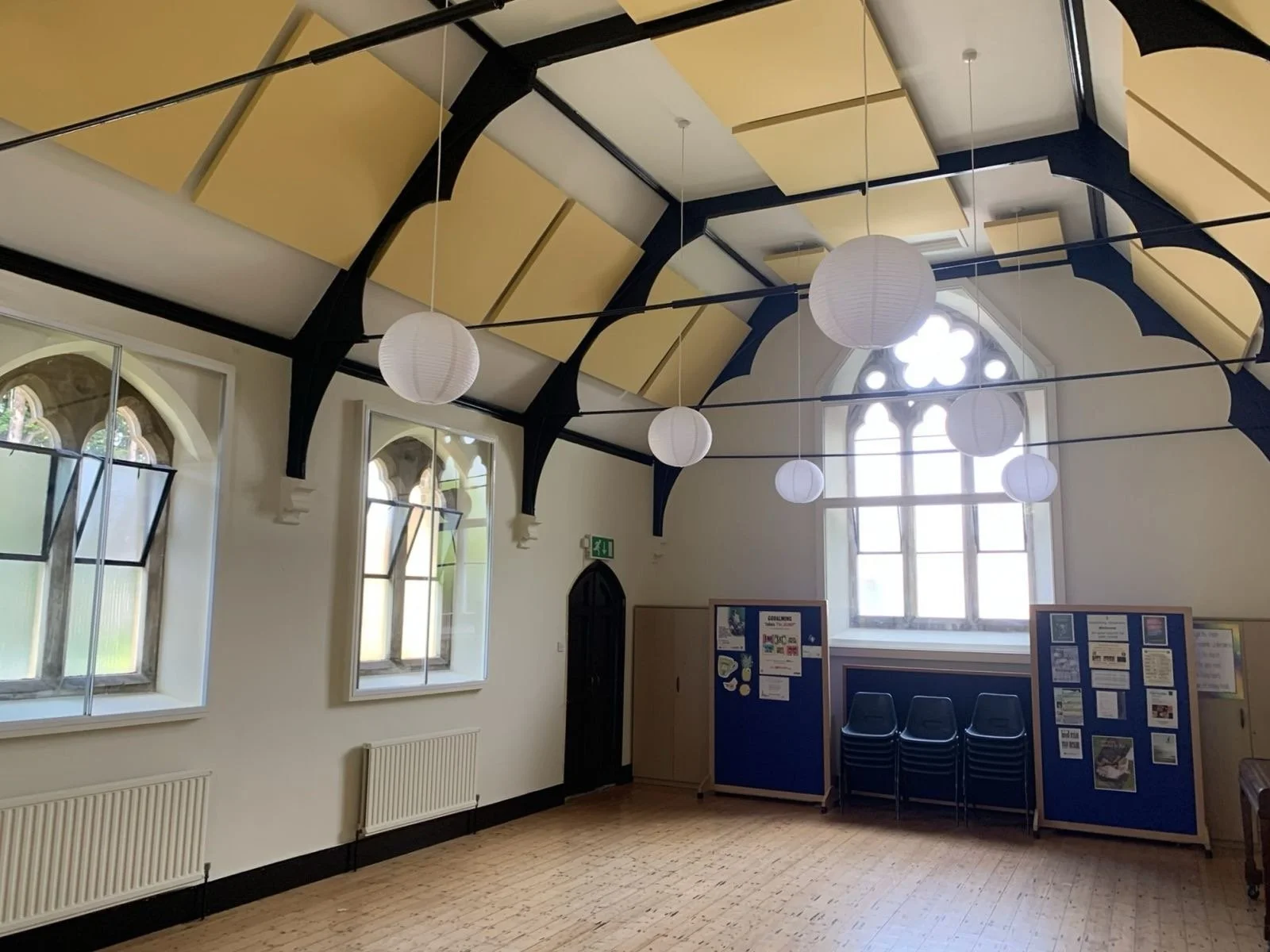
Unitarian Hall, Godalming, Surrey
Sound Reduction Systems Class A rated Sonata Vario panels suspended from the ceiling.
Why was this such a boon? This hall had a notoriously nasty acoustic, making it very difficult to hear conversations or speakers, and well-nigh impossible for those with hearing aids. The fitting of these panels made the room much easier for everyone.
Here is a very simplified explanation as to why this happens.
So many meeting places have very bad acoustics. It is fashionable for all surfaces to be hard and shiny – not just walls and windows, but floors and ceilings too. When someone is speaking, the sound waves hit these surfaces and change course. At each change the wavelength changes very slightly, blurring the sound. Once these wavelengths start crossing each other, the clarity of the sound is further reduced. The sound entering your ear channel, or your hearing aid, becomes less distinct.
Acoustic panels present a softer surface, thus improving the quality of the sounds circulating around the room. A similar effect could be obtained by installing soft furnishings, drapes and carpets, but these are not so easy to keep clean, so it is understandable why hard surfaces are so popular.
The example given above illustrated one voice. Consider how much worse the sound gets when there are lots of people chatting, maybe over a drink or a meal – with the added noise of cutlery, and possibly background music – and you can see why so many people complain they have trouble hearing in noisy environments, regardless of whether they have actual hearing impairment.
For the hearing impaired, there is the added issue that hearing aids are much better at picking up hard mechanical sounds than they are softer sounds such as the human voice.
I recently had the misfortune to attend a networking meeting in the Oglethorpe Room at the Wilfrid Noyce Centre in Godalming. Armed with my new multimic (see Technology Comes to the Rescue) I went along in the expectation that this would be a useful meeting. Not so. This meeting room has no T-loop, and all the surfaces are hard. The tables were set out in a square with seating for 15 or 16 people. It turns out my multimic only picks up voices within a fairly short range – so excellent for a committee of 7 or 8 people, less so the bigger the table gets. I left the meeting not having very much idea of what most of the people there had been talking about, and exhausted by the effort of trying to lipread so many other people. Interestingly, over coffee a couple of people complained that they could not hear very well, so it was not just me, though my hearing loss made it worse.
If the management of the Wilfrid Noyce Centre are reading this, I would strongly urge them to fit acoustic panels to that room.
If all this talk of acoustics and straining to hear has struck a chord, here's a good reason to join us. At GHOHSG we practise lipreading every fortnight, so you build up the skills that help you cope when a room lets you down. And if you'd like a proper grounding, our Managing Hearing Loss Course starts this September – six sessions, face to face, run by our own tutors. Enrolment is open now, but places are limited, so don't leave it too long.